Musashi Dojo is open for testing
What is Musashi Dojo?
The Musashi Dojo is a public Cardano testnet for Ouroboros Leios. Running from late June 2026 through the mainnet hard fork, it hosts successive node releases, from early prototypes to release candidates.
Input Output (IO) operates the network, while independent SPOs run Leios-enabled block producers and participate in consensus. The testnet evolves with each release, providing an environment for testing, validation, and performance analysis.
Our partners
Why Musashi Dojo?
Cardano was born in Japan, where its earliest community took shape
Many early supporters, today’s operators, and current builders are Japanese or work closely with the Japanese community. Ten years on, this remains one of the deepest and most enduring connections in the blockchain industry.
This testnet reflects that legacy.
The Musashi Dojo enters its next phase: Water
In the Book of Five Rings, water is the element that adapts. It flows around whatever stands in its way and fills any container it is poured into without losing what it is. That mindset shapes this phase.
The protocol design stays fixed. What we change is everything around it. We run Leios across a wide spread of configurations, adjusting timing and size settings and swapping in different builds of core components, to find the setup that moves the most transactions per second on testnet. Each run answers two questions: how much throughput Leios reaches today, and where the next gain is waiting. Sharpening the parameters that will ready Leios for mainnet.
The path to mainnet
At the end of this program, Cardano will support an initial 5 to 20 times increase in throughput capacity, validated across protocol design, parameter choices, and implementation.
Even the thousand-mile road, we cross step by step
Miyamoto Musashi, Book of Five Rings, Water book
The phases
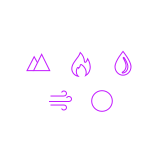
The testnet moves through five stages, each named after a book in Musashi's 1645 treatise, the Book of Five Rings.
The stages describe where the program's focus moves over time. In practice, work on one stage can overlap with another.
The program begins in late June 2026 and progresses through the stages in sequence. The story is progression: each stage builds on the work of the last.
The five phases outlined here represent our current planning view. Release dates are indicative and subject to change as development, testing, and governance processes evolve. We will communicate any updates as
they arise.
For stake pool operators

get a Leios node running and synced to the Dojo testnet
set up keys, register your pool, and start producing blocks on the testnet
use the faucet to request test ada and pool delegation so your block producer has stake to work with
follow each phase's guidance, watch the behavior, and provide feedback
For builders
Leios changes how much Cardano can carry, not the contracts already running on it. Testing DApps, indexers, wallets, and other tooling on the Leios testnet helps identify any issues and prepare for the transition to mainnet.
Why build now
- Get ahead of the curve: adapt for Leios on your own schedule, not on launch day
- Shape the protocol: builder feedback during the testnet feeds the parameter adjustment and the implementation directly
- A safe place to break things: it's a testnet – test ada is free from the faucet, and nothing reflects on mainnet

Documentation
Step-by-step operator documentation is published on the docs site and updated through each phase of the testnet.
While builder documentation is in development, refer to CIP-164 for the protocol design and the Ouroboros Leios repository for implementation details